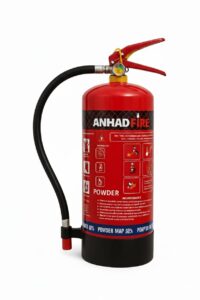
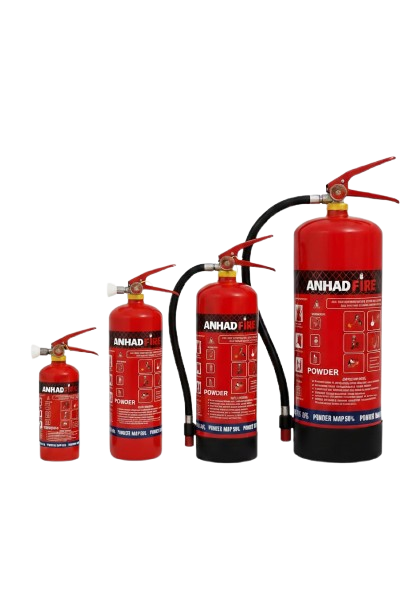
ABC DRY CHEMICAL (MAP 50 & 90) FIRE EXTINGUISHER
ABC fire extinguishers are often the ideal choice because they
can put out many different types of fires. They use a dry chemical
known as monoammonium phosphate that can quickly put out the
fire. It is a pale-yellow powder that is used to extinguish three classes
of fire. ABC fire extinguishers are considered “multi-purpose” extinguishers
which can be used on Class A, B,C fires as well Electric Fire.
The letters stand for the class of fire the extinguisher can be used against:
Class A
Extinguish fires involving paper, wood,
textiles, cloth, rubber, trash, and plastics
Class B
Extinguish fires involving flammable
liquids, solvents, oil, gasoline, paints,
lacquers, and other oil-based products
Class C
Extinguish fires involving energized
electrical equipment such as wiring,
controls, motors, machinery, and
appliances.
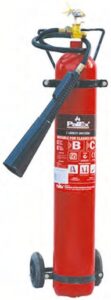
CARBON DIOXIDE FIRE EXTINGUISHER
Co2 fire extinguishers are often the ideal choice for liquid & Gas
started fires. Flammable liquids such as petrol and oil (Class B) &
Flammable gases are highly combustible in nature. A single spark
of fire can lead to an explosive fire incidence, which in no time can
turn into an inferno. Our CO2 Fire Extinguishers are Packed with
tremendous power, which cut off the oxygen supply, and bring the
temperature down drastically, stopping the fire in seconds.
The letters stand for the class of fire the extinguisher can be used against:
Class B
Extinguish fires involving flammable
liquids, solvents, oil, gasoline, paints,
lacquers, and other oil-based products
Class C
Extinguish fires involving energized
electrical equipment such as wiring,
controls, motors, machinery, and
appliances.
MECHANICAL FOAM (AFFF) FIRE EXTINGUISHER
AFFF Foam Extinguishers are suitable for use on Class A & B Fires. Foam extinguishers
are especially good for use on material fires that are caused by wood, paper and textiles,
cooling the flame by evaporation of the water in the foam. Good at combating flammable
gases, as the foam creates a barrier between the flame and fuel.
Another good feature of the AFFF Foam Fire Extinguisher range is that the substance is non
toxic and will not damage most materials.
The letters stand for the class of fire the extinguisher can be used against:
Class A
Extinguish fires involving paper, wood, textiles,
cloth, rubber, trash, and plastics.
Class B
Extinguish fires involving flammable liquids,
solvents, oil, gasoline, paints, lacquers, and
other oil-based products
WATER BASED FIRE EXTINGUISHER
Water fire extinguishers are used to extinguish class A fires, or in other words fires
Involving flammable solids such as paper, wood, and textile materials. They are most
commonly used within environments containing combustible materials such as
warehouses, textile factories, storage facilities and office spaces. It can also be
beneficial to use a water fire extinguisher within a domestic setting such as living
rooms and bedrooms.
WATER
Water fire extinguishers cannot be used on electrical fires.
The letters stand for the class of fire the extinguisher can be used against:
Class A
Extinguish fires involving paper, wood, textiles,
cloth, rubber, trash, and plastics.
CLIENT AGENT BASED FIRE EXTINGUISHER
Clean Agent Fire Extinguishers contain environment friendly HFC gas as
an extinguishing agent. Clean agent is a fire suppers Sant stored as liquid
that discharges in the form of gas. Our Clean Agent Fire Extinguishers are
effective for use on Class A (ordinary solids), Class B fires (flammable liquids)
and Class C fires (flammable gases). These fire extinguishers can also be
used on electrically actuated fires.
Clean Agent Fire Extinguishers are environmentally safe, leaves no residue
and intended for the protection of facilities where electrical panels or
electronic equipment’s are installed.
Clean agent extinguishers act to extinguish a fire by smothering effect.
As the extinguishing agent does not conduct electricity back to the user,
they are most effective on electrical fires.
The letters stand for the class of fire the extinguisher can be used against:
Class A
Extinguish fires involving paper, wood,
textiles, cloth, rubber, trash, and plastics
Class B
Extinguish fires involving flammable
liquids, solvents, oil, gasoline, paints,
lacquers, and other oil-based products
Class C
Extinguish fires involving energized
electrical equipment such as wiring,
controls, motors, machinery, and
appliances.